

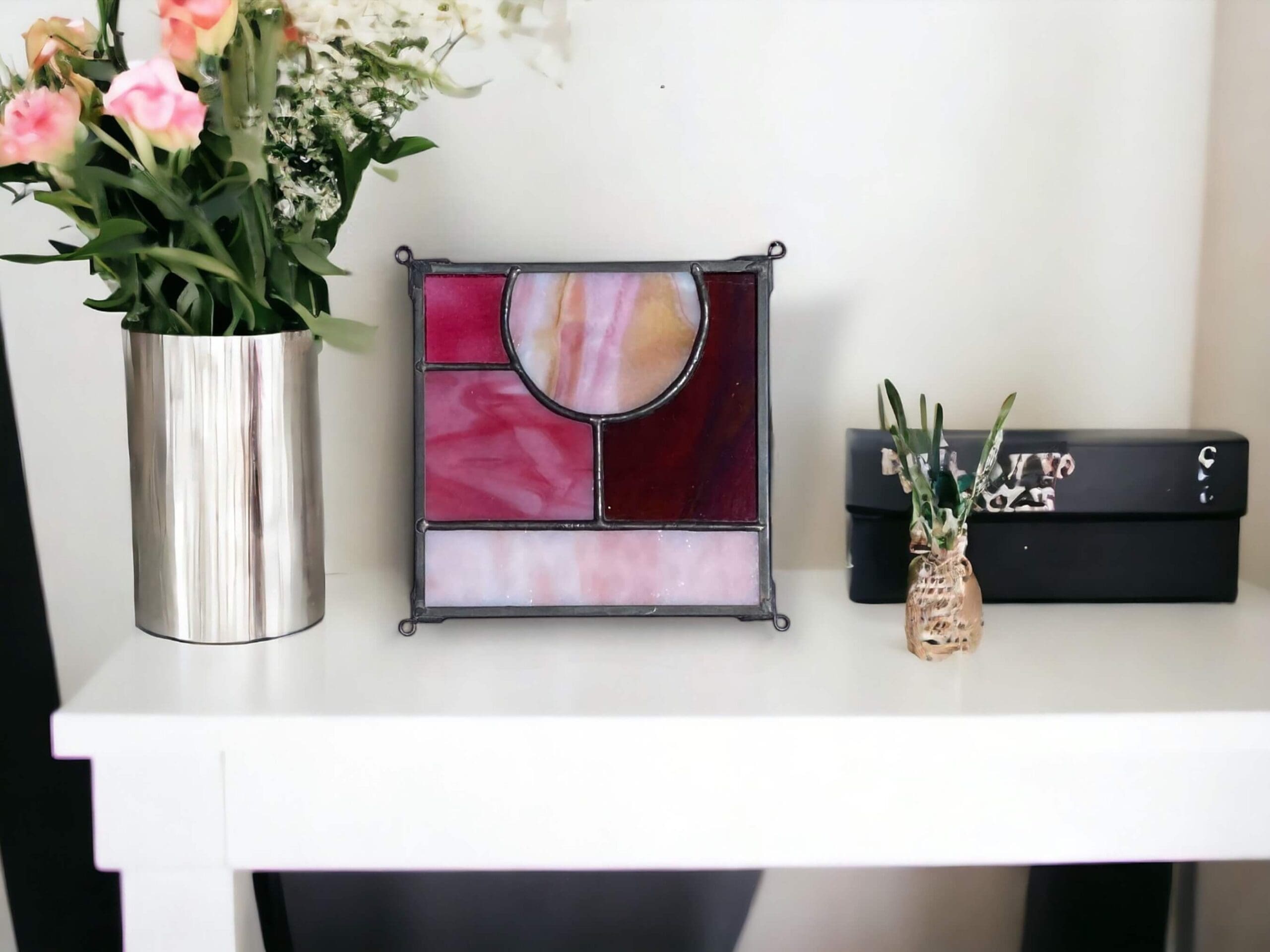
Stained glass is colored glass cut into shapes and joined into a single design, and it comes alive the moment light passes through it. For centuries, that idea lived mostly in cathedrals and civic buildings. Today, it’s finding its way into everyday homes, and I think that’s where it does some of its best work.
I came to stained glass after 34 years in the construction insurance industry, and I’m still struck by how much one panel can change a room.
In this guide, I’ll walk through what stained glass is, how it’s made, a few stained glass styles you’ll see most often, and how to bring its beauty into your home.
What Is Stained Glass?
Stained glass is glass colored all the way through, usually by adding metal oxides while the glass is molten, then cutting it into pieces and joining them into a single design. Ordinary window glass is made to be clear.
- Cobalt produces deep blues.
- Copper gives greens.
- A small amount of gold creates warm ruby reds.
Some glass is also painted or treated with a silver stain after it’s made, which is part of where the name comes from.
An artist cuts that glass into individual pieces, fits them together, and joins them with metal to form a panel. Those metal lines become part of the design. In my work, they’re as deliberate as the color, and they give a geometric piece its structure.
Light finishes the piece. A panel looks one way at 8 a.m. and another by late afternoon. Overcast days soften the colors, and bright sun throws them across the floor. This is the part I love playing with the most when creating stained glass designs.
That’s why I think of stained glass as both art and architecture. You choose it for its beauty, and it also does real work in the building by filtering light, providing privacy, and filling an opening that would otherwise be plain glass.
A Brief History of Stained Glass
People were coloring glass long before anyone built a window with it. Ancient Egyptian and Roman artisans made colored glass vessels, beads, and mosaics, and the Romans set small panes of glass into some of their buildings.
Stained glass reached its height in medieval Europe, especially in France during the Gothic period of the 12th and 13th centuries. Churches used large windows to tell religious stories to congregations who mostly couldn’t read, and some of the oldest windows still in place are roughly 900 years old. Gothic architecture made walls thinner and windows taller, and buildings like Chartres Cathedral and Sainte-Chapelle in Paris turned whole walls into glass.
The craft had a second wave in the 1800s. Victorian builders brought stained glass into houses, while the Gothic Revival renewed interest in church stained glass windows. Toward the end of the century, Louis Comfort Tiffany popularized the copper foil technique, which allowed finer detail and tighter curves. Soon after, Frank Lloyd Wright was designing geometric “light screens” for his Prairie-style homes, windows meant to be part of the architecture itself.
Contemporary artists, me included, still work with the same methods, but stained glass today leans toward clean lines, abstraction, and color used with restraint.
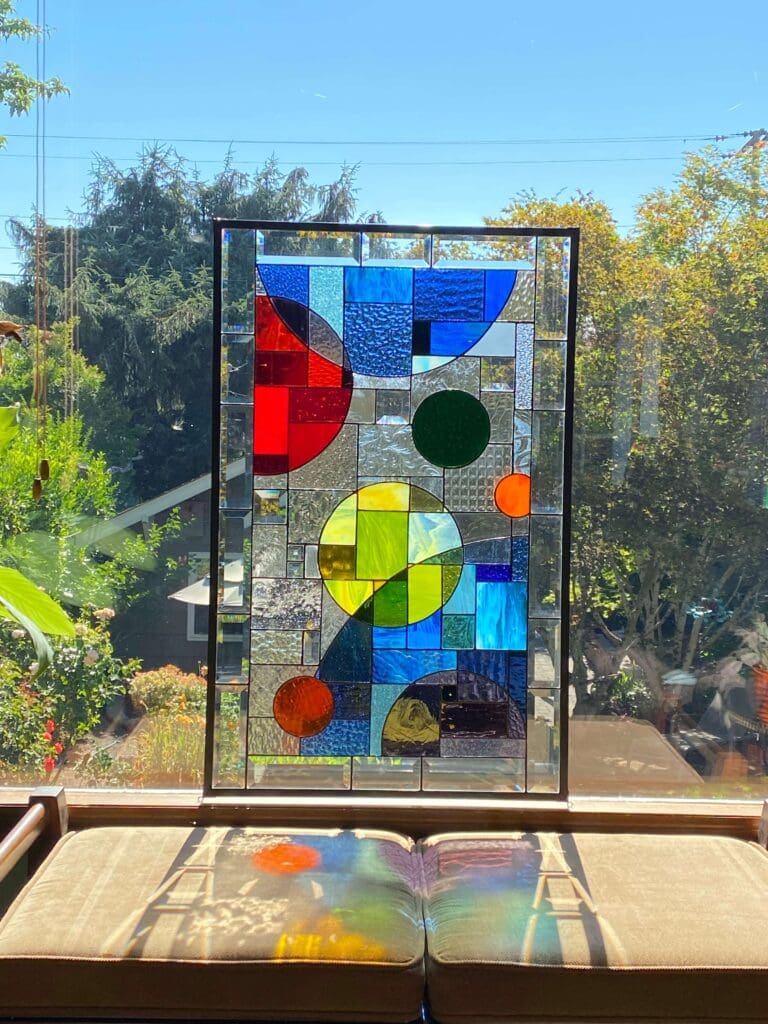
7 Popular Stained Glass Styles
Stained glass covers a wide range of looks, and the right style usually depends on the house’s architecture and how much you want the glass to stand out. These are the six you’ll come across most often.
1. Traditional and Medieval Stained Glass
Medieval stained glass features saturated color, detailed imagery, and patterns built from several small pieces. Floral motifs, geometric borders, and figurative scenes are common, and the style fits well in historic homes and large statement windows where the glass is meant to be the focal point.
2. Victorian Stained Glass
Jewel tones, botanical motifs, and decorative borders are common in Victorian styles. They are usually arranged symmetrically and layered with beveled or textured glass in entry doors and stair windows (more on beveled glass below).
3. Art Nouveau Stained Glass
Art Nouveau stained glass has flowing lines and organic shapes, with flowers, leaves, and vines curving across the panel. It appeals to people who love artistic detail and vintage design.
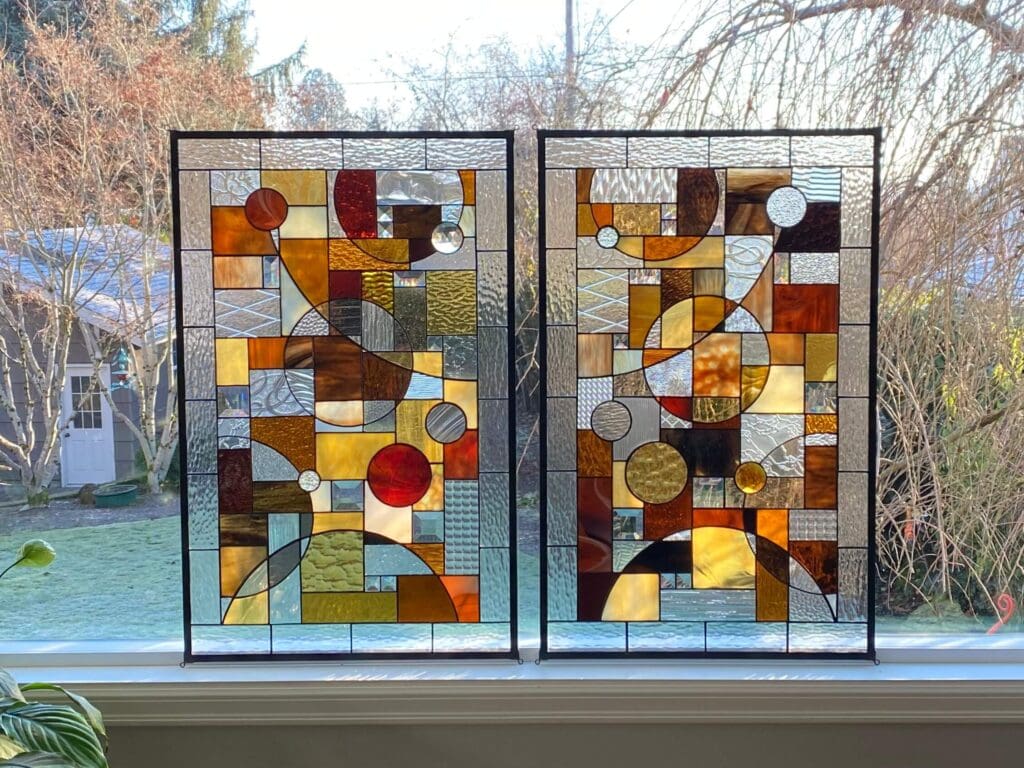
4. Geometric and Prairie-Style Stained Glass
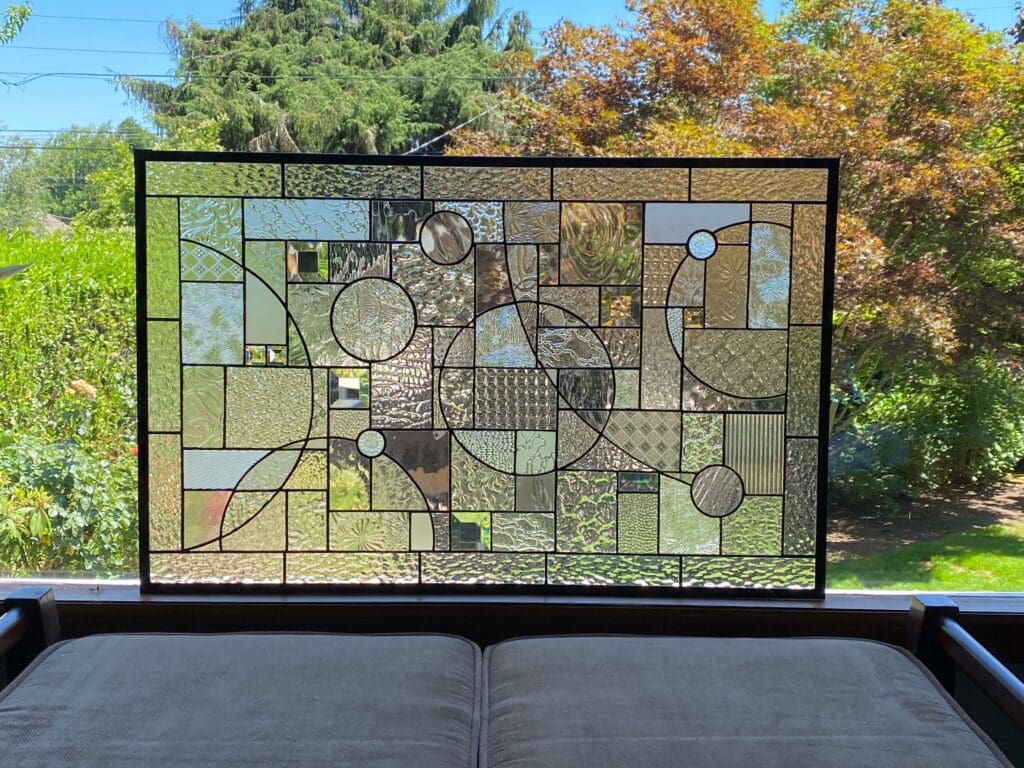
This style has clean lines, repeating shapes, and structured compositions, with large areas of clear or lightly textured glass and color used as an accent. It sits comfortably in mid-century modern interiors and minimalist rooms.
5. Art Deco Stained Glass
Art Deco took hold in the 1920s and 1930s with sunbursts, chevrons, fans, and stepped shapes, often in high-contrast palettes. It shares contemporary work’s love of structure, which is why it looks as much at home in a modern interior as it does in a period house.
6. Contemporary and Abstract Stained Glass
Contemporary stained glass uses bold color, asymmetry, and shapes that don’t follow a traditional template. A contemporary piece can stand on its own as a piece of art or anchor a room as its focal point. If you want something no one else has, this is the style for you. This is also where I spend most of my time creating in the studio.
7. Nature-Inspired and Botanical Stained Glass
Botanical designs bring organic color inside. A set of windows I made for a client in Austin pairs tessellated birds and fish with geometric panels, and it’s a good example of how comfortably nature and geometry can share a wall.
Types of Stained Glass
The glass itself shapes how a finished piece looks and how much of a view it hides, long before any design is drawn. These are the types you’ll hear about most.
Cathedral glass: Transparent colored glass. Light passes straight through, and you can still make out shapes on the other side, so it suits spots where color matters more than privacy.
Opalescent glass: Milky glass that diffuses light as it passes through. Louis Comfort Tiffany made it famous, and it gives more privacy than cathedral glass.
Textured glass: Clear or colored glass with a surface pattern, like seeded glass with tiny trapped bubbles or hammered and rippled finishes. It blurs the view while letting daylight in, which makes it a go-to for privacy windows.
Streaky glass: Two or more colors swirled together in one sheet, so every piece cut from it is a little different.
Beveled glass: Thick clear glass with its edges ground and polished at an angle. The bevels act like small prisms and scatter rainbows when the sun hits them, which is why you see them so often in front doors and Victorian entries.
How Is Stained Glass Made?
Every stained glass panel moves through the same basic stages, whatever the technique.
- Design. A full-size drawing, often called a cartoon, is made at the exact dimensions of the opening.
- Pattern. The drawing is traced and cut into pattern pieces, with room left for the metal that will join them.
- Cutting. Each piece is scored and broken from a larger sheet, then ground so its edges fit cleanly.
- Assembly. The pieces are wrapped in copper foil or fitted into lead came, depending on the technique.
- Soldering. The joints are soldered so the panel becomes one solid piece.
- Finishing. Came panels are cemented to stiffen and weatherproof them, and every panel is cleaned, given a patina if the design calls for it, and polished.
Soldering is the step I’ve practiced longest. I spent summers tinning soldering tips before moving on to assembling circuit boards with my dad, years before I ever cut a piece of glass.
The technique behind a piece shapes how it looks, how much detail it can hold, and how well it stands up over the years. These are the main methods you’ll hear about.
Lead Came Construction
Pieces of glass are fitted into grooved metal strips called came, and each joint is soldered where the strips meet. Lead is the traditional material, and zinc, brass, and copper came are also used.
This is what people usually mean by leaded glass — it means any window or panel made from glass pieces held together with lead came — and it’s the standard for larger architectural panels and traditional windows because the came creates strong outlines that hold the whole design together.
Copper Foil Technique
The edges of each piece are wrapped in thin copper foil, and the seams are soldered into a continuous bead. Because the foil is so thin, this method works well for smaller pieces and finer detail. You’ll usually see it in decorative panels, lampshades, and detailed contemporary work.
Glass Painting and Staining
Specialized glass paints and silver stain add shading, lines, and imagery to the surface. The glass is then fired in a kiln so the paint bonds permanently. This is how traditional windows get faces, lettering, and fine detail that cut glass can’t produce.
Fusing and Other Contemporary Techniques
Fused glass is made by stacking compatible pieces and heating them in a kiln until they bond into one sheet. It’s related to stained glass but is a separate process, since nothing holds the pieces together but the glass itself. Some stained glass artists also layer textured, clear, and colored glass to add depth and to control how much of the view a window reveals.
Where Does Stained Glass Belong in Your Home?
Stained glass works in more places than a single front window. These are the rooms and openings where I see it make the biggest difference.
Entryways and Front Doors
Sidelights, transoms, and door glass are some of the most visible openings in a house, and they’re often where privacy matters most. A custom design can follow the home’s existing architecture so it feels like it was always meant to be there.
Kitchen Windows and Cabinet Doors
The window over the sink is a natural spot for stained glass, since you look at it every day and it could face a neighbor. Botanical and geometric designs both work well here, and a soft palette also works, letting the kitchen’s finishes lead.
Glass inserts in upper cabinet doors are another way to bring color into the room. Pay attention to how the sun moves through the kitchen, because the same panel can look completely different at breakfast and at dinner.
Bathroom Windows for Privacy
This is the request I hear most often. A window beside a tub or shower has to block the view without darkening the room, and textured, patterned, translucent glass can do that while still letting daylight through. Anything installed in a bathroom should be designed and glazed with moisture in mind.
One detail that surprises people is that you can install stained glass on the interior side of an existing thermal window. You keep the energy efficiency of your existing double-pane window and add privacy and color on the inside.
You’ll also see window film printed to look like stained glass. It’s inexpensive and easy to peel off, and it’s also a flat printed image on plastic, without the depth, texture, or shifting color you get from cut glass.
Transom Windows and Interior Dividers
A transom above a door adds character without taking over the room. Inside the house, stained glass works in interior doors, room dividers, and openings between rooms. It separates one area from the next while keeping color and light moving naturally through the home.
Living Rooms and Statement Windows
In a living room, a custom panel can become the focal point the rest of the room is arranged around. The strongest designs take their cues from what’s already there, including the furniture, the art on the walls, and the direction of the light. If you aren’t ready for a permanent installation, a panel hung in a sunny window gives you the same effect.
Standalone Art and Decorative Accents
Smaller works like framed panels and hanging pieces let you bring stained glass into your home without remodeling anything. They’re an easy way to choose colors and shapes that suit your own taste.
This is often where people start before commissioning something larger. The ready-made pieces in my shop are made for this.
What to Consider Before Adding Stained Glass to Your Home
A few practical decisions will shape the design long before any glass is cut, and they’re worth thinking through before you contact an artist.
- Light and Placement: Notice which direction the window faces, how much sun it gets, and how the light shifts from morning to evening.
- Privacy: Decide whether the glass needs to block a view or is mainly there for beauty. That choice drives how much textured or opalescent glass is used in the design.
- Design and Color: Choose a style that works with the existing architecture of the house.
- Size and Scale: Consider whether you want the glass to blend into the room or stand out as its focal point.
- Installation: Stained glass window installation can mean a new custom window, a replacement panel, a panel added to the interior side of an existing window, or a removable piece.
- Budget: Price depends on dimensions, design complexity, the glass selected, technique, and installation requirements. A small panel with a simple layout and a large window built from hundreds of pieces sit at very different price points.
Bring Your Vision to Life With Custom Stained Glass
A well-made stained glass piece brings color, craftsmanship, and a piece of you into a home, and it keeps changing with the light for as long as it’s there. It might be a front door, a bathroom window, or a panel catching the sun in the kitchen, and it can look as modern as the rest of your house.
Every custom commission I take starts with a conversation about your home, the opening, the light, and what you want the glass to do. From there, I develop a design for your approval, and once it’s approved, fabrication typically takes 8 to 10 weeks, depending on project scope and my studio schedule. You work directly with me from the first idea to the finished piece, and I ship nationwide.
Explore my portfolio to see installed work, shop ready-made pieces, or start a custom commission inquiry and tell me about your project. I’d love to hear what you have in mind.


